
How the face shape detector works
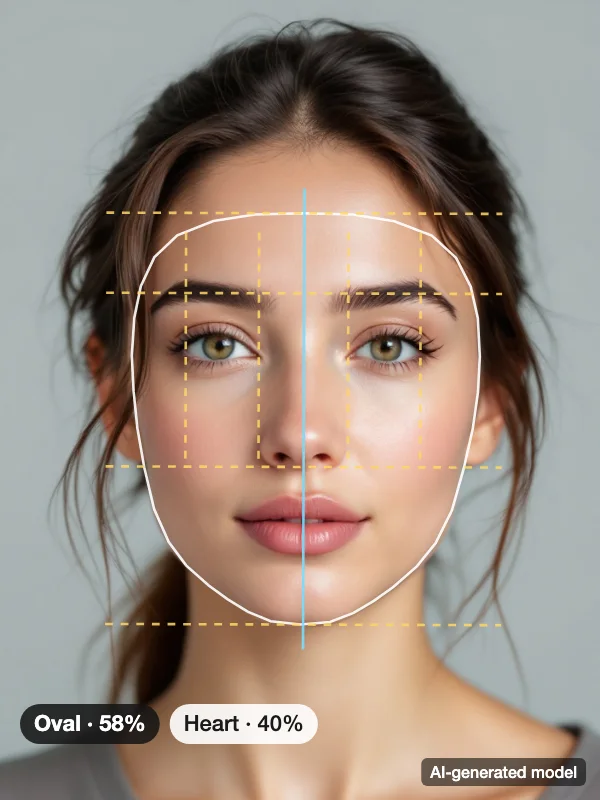
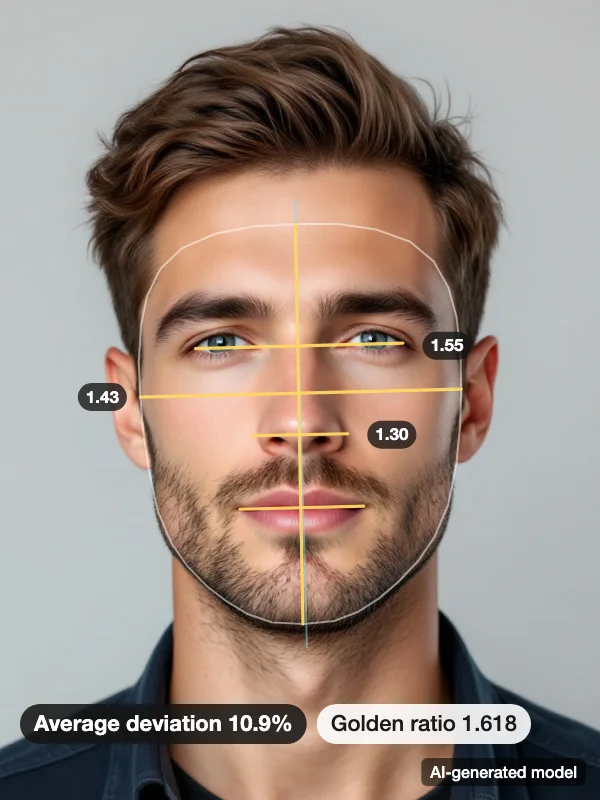
This face shape detector measures your face instead of asking you to guess. When you add a photo, Google's MediaPipe Face Landmarker maps 478 points across your face, right in your browser. The detector turns those points into a few distances and ratios, scores them against a rule for each of the seven shapes, and shows the shape that fits best, or two shapes when your face sits between them.
Each rule describes an outline in numbers, such as "at least 1.5 times longer than wide" for oblong. The rules (version shape-0.1) are still being tuned on annotated test photos, so borderline results may shift slightly.
What the face shape detector measures
Every result from the face shape detector rests on six measurements taken from those landmark points:
- Face length, hairline to chin. Hair often hides the hairline, and the face mesh stops just below it, so this is an estimate.
- Forehead width, across the outline of your face at the height of your brow arches.
- Cheekbone width, straight across at cheekbone level. The other widths are compared with this one.
- Jaw width, between the points where your jawline turns toward the chin.
- Jaw corner angle, averaged over both sides. A wide, open angle reads as soft, and a tighter one as defined.
- Chin width, just above the bottom of the chin, compared with the width of your mouth. A chin that is narrow for your mouth reads as pointed, one of the signs of a heart shape.
These become a handful of ratios, such as length ÷ cheekbone width and jaw ÷ cheekbone width, and each shape rule checks a few of them. The checks are soft rather than pass or fail. A face just past a cut-off, for example a little longer than the 1.5 times that separates oval from oblong, loses some of its oval score instead of dropping out, so a tiny difference near a cut-off moves the result gradually rather than all at once. The seven scores then become probabilities, one for each shape.
When one shape clearly leads, you see its name. When the top two are close, the result reads "Between X and Y", with the more likely shape first. Either way, a confidence level shows how clear-cut the call was, and the full report lists your top two probabilities along with the measurements that set them apart.
What is my face shape? The 7 shapes at a glance
The detector answers with one of these seven shapes, or with two when your face sits between them. Each has its own page, and the face shapes guide compares all seven side by side.
- Oval: about 1.3 to 1.5 times longer than wide, widest at the cheekbones, with a jaw no wider than the forehead and soft corners
- Oblong: at least 1.5 times longer than wide, with forehead, cheekbones and jaw within about 10% of each other
- Round: up to about 1.25 times longer than wide, widest at the cheeks, with a fairly wide jaw and soft corners
- Square: up to about 1.3 times longer than wide, with a jaw nearly as wide as the cheekbones and angular corners
- Heart: a forehead nearly as wide as the cheekbones, a narrower jaw and a slim or pointed chin
- Diamond: widest at the cheekbones, with a clearly narrower forehead and jaw
- Triangle: widest at the jaw, with cheekbones wider than the forehead
How to take a photo the detector can read
A few habits make your photo easier to measure:
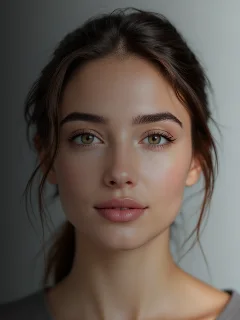
- Face the camera straight on, with your eyes level.
- Keep a neutral expression: eyes open, mouth closed, no smile.
- Take off your glasses and show your forehead, pushing back any hair that covers your hairline or jaw.
- Stand about 3 feet (1 meter) away. Front cameras distort faces up close, so prop your phone up or ask someone to take the photo.
- Use even light, with no strong shadow on one side of your face.
If a photo fails a quality check, such as a face too small in the frame, a turned or tilted head, a smile, blur, poor light or a second face, the face shape detector tells you why and asks for another.
Double-check with a mirror and a tape measure
Want to answer "what face shape do I have?" by hand? You need a flexible tape measure and a mirror. Hold the tape straight across rather than wrapping it around your face.
- Face length: from the center of your hairline straight down to the bottom of your chin.
- Cheekbone width: across the widest points of your cheekbones, just below the outer corners of your eyes.
- Forehead width: across the widest part of your forehead.
- Jaw width: from one jaw corner, below the ear where the jaw turns upward, to the other.
Divide face length by cheekbone width, note which of the three widths is largest, and compare with the list above. Hand measurements are rough, so treat differences of a few percent as a tie.
Face shape detector vs. quizzes and tape measures
A quiz asks you to judge your own features, which is hard to do by eye. A face shape analyzer measures them directly, so the two can disagree. Results also vary because:
- Charts differ. Some leave out diamond or triangle, and one chart's oblong is another's rectangle.
- Quizzes force a choice, even when a face sits between two shapes.
- Photos vary. Lens distortion, head pose, expression, hair over the forehead or jaw, and lighting all shift the numbers. That is why the shape call, and every measurement in the full report, comes with a confidence level.
A tape measure is closer to what the detector does, since it measures rather than guesses. It follows your real hairline, which a photo can't always show, but it is hard to hold perfectly straight or to find the same jaw corner twice.
Expect your tape-measure ratio to read higher than the face length ÷ width number on screen, because the face mesh starts at the top of the visible forehead, just below the hairline. The detector converts that to a hairline-based estimate before applying the shape rules, and the ratios in the list above are hairline-based too.
If the face shape detector and your tape measure point to neighboring shapes, read both shape pages. A face near a border often suits ideas from each.
What you get for free, and in the full report
The free result includes:
- Your face shape, or "Between X and Y" when two shapes are close
- A Harmony Score that summarizes six proportions. It measures geometry, not attractiveness; the attractiveness test page explains it.
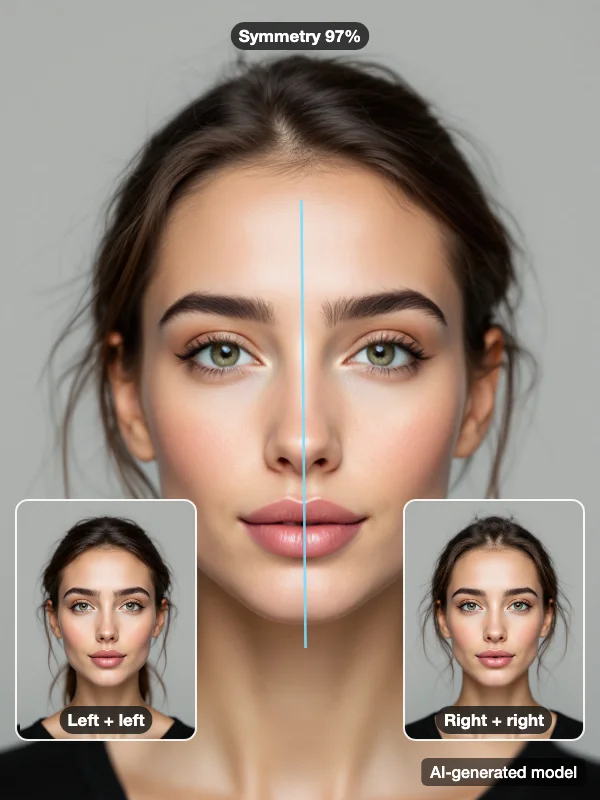
- Three core measurements: face length ÷ width, facial thirds (upper : middle : lower, with the upper third estimated) and overall symmetry, explained by the face symmetry test
- A result card image, plus a share link that carries only your numbers, never your photo
The optional full report costs $12.99 once, with no subscription. It adds 21 measurements with reference ranges and confidence levels, a symmetry map, your top two shape probabilities explained, and styling suggestions for your measured shape: hairstyles, glasses frames, beard styles, contour and highlight zones, necklines, earrings and hats. It also has quick wins, photo tips, limitations and a PDF download, and you sign in with your email to buy it. For classic proportions, try the golden ratio face calculator.
A selfie can also answer "what is my eye shape?" For the rest of your proportions, from facial thirds to eye spacing, see face analysis.
Your photo stays on your device
The scan runs entirely in your browser, and the photo you scan is never uploaded. Your result is kept in this browser for 24 hours, and you can clear it at any time. If you buy a report, only derived numbers (your ratios) are sent to the server, never the photo.
There is no face recognition, no identity or look-alike matching, and no guessing of age, gender, emotion or ethnicity. The face shape detector measures shapes and distances, and nothing more.
Updated 2026-09-26