

What a golden ratio face means
The golden ratio face idea is simple: take two measurements of a face, divide one by the other, and see how close the answer comes to 1.618. This golden ratio face calculator does that for six classic pairs of measurements from a single selfie, lists each ratio next to 1.618, and shows how far, on average, they sit from it. It is a design rule of thumb, not a beauty score. Below you will find what each number means and where the idea falls short.
Where 1.618 comes from
The golden ratio appears when you split a line into two parts so that the whole line relates to the longer part exactly as the longer part relates to the shorter one. That works out to (1 + √5) ÷ 2, about 1.618, and it is often written with the Greek letter phi. Ratios of neighboring numbers in the sequence 1, 1, 2, 3, 5, 8, 13, 21 creep toward it: 13 ÷ 8 is 1.625, and 21 ÷ 13 is about 1.615.
Greek geometry described this proportion more than two thousand years ago, and Renaissance writers praised it as the "divine proportion". Today it is a popular rule of thumb in art and design. Many stories about it, such as famous buildings or paintings being planned around 1.618, are repeated often but disputed. The idea that faces should follow it is popular too, but it has never been an established scientific standard.
The six ratios the golden ratio face calculator compares
Each ratio divides a longer distance by a shorter one and is compared with 1.618.
- Face length ÷ face width: hairline to chin, over the width across your cheekbones. The face mesh starts just below the hairline, so this uses a hairline-based estimate.
- Mouth width ÷ nose width: corner to corner of the mouth, over the width of the nose.
- Nose tip to chin ÷ mouth to chin: how the lower face divides around the mouth.
- Face width ÷ outer eye corners: cheekbone width, over the distance between the outer corners of your eyes.
- Brow line to mouth ÷ mouth to chin: the stretch from your brows down to your mouth, over the stretch below it.
- Nose length ÷ nose width: from the bridge between your eyes to the base of your nose, over nose width.
Face length ÷ width also helps separate oval from oblong faces in the face shape detector, though there the cut-offs come from shape definitions, not from 1.618.
How to read your average deviation
For each ratio, the calculator works out the gap to 1.618 as a percentage of 1.618. A mouth-to-nose ratio of 1.50, for example, sits about 7% below it. The six gaps are then averaged into one number, so 0% would mean every ratio lands exactly on 1.618.
Typical faces deviate by several percent on average, and single ratios can sit much further away. That is normal. A lower deviation is not better looking, and a higher one is not a flaw: it only tells you how closely your proportions happen to match a classic design pattern.
If you want to calculate golden ratio face numbers by hand, use the same method with a ruler on a straight-on photo. Tiny measuring errors move the result quickly, so measure each distance twice.
A worked example on a synthetic face
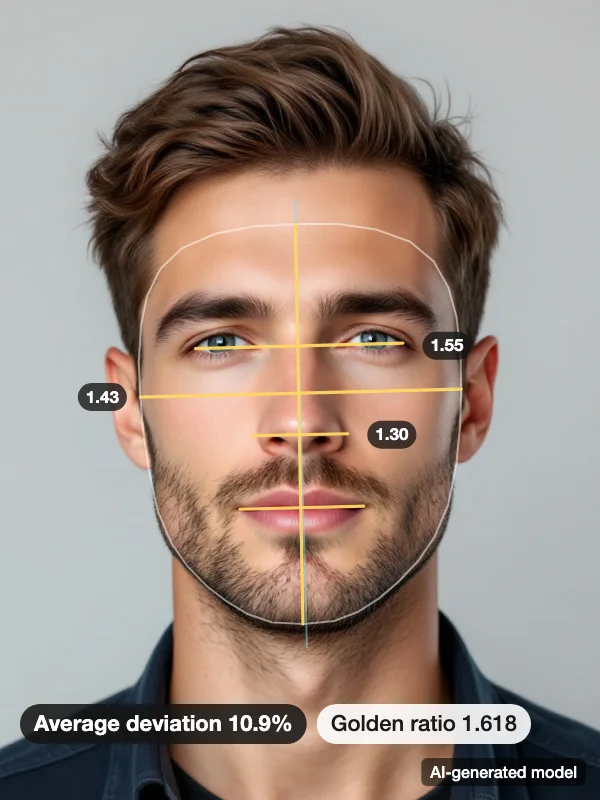
Here is the golden ratio face calculator run on a synthetic face: the computer-generated average face we test the calculator on, not a photo of any person. Its six ratios, in the order listed above, are:
- Face length ÷ face width (hairline estimate): 1.33
- Mouth width ÷ nose width: 1.38
- Nose tip to chin ÷ mouth to chin: 1.61
- Face width ÷ outer eye corners: 1.72
- Brow line to mouth ÷ mouth to chin: 1.64
- Nose length ÷ nose width: 1.50
Two of the six land within 2% of 1.618: nose tip to chin at 1.61, and brow line to mouth at 1.64. Two more sit about 6 to 7% away, one on each side: face width ÷ outer eye corners above it at 1.72, and nose length ÷ nose width below it at 1.50. The first two are furthest off, about 18% and 15% below 1.618, because this face is wider for its length, and its nose wider for its mouth, than the 1.618 pattern assumes.
Averaged, the six gaps come to 8.1%. The calculator works with unrounded values, so averaging the rounded ratios above by hand gives a figure a touch lower.
Read the average together with the single ratios. The same 8.1% could come from six ratios that are all moderately off, or from four that sit close to 1.618 and two that sit far from it, as here. The list tells you which pattern you have. Some ratios also move together: the second and sixth both divide by nose width, so anything that changes how wide your nose looks in the photo shifts both at once. And even this averaged, computer-made face sits several percent from 1.618, in line with typical faces, so a gap of that size is ordinary, not a shortfall.
When you scan from this page, your result shows the same six numbers for your own photo, in the same order and next to the 1.618 target, along with your average.
The "new golden ratio" research
A more modern take comes from a 2010 study. Researchers Pallett, Link and Lee varied the spacing of the eyes and mouth in face images and asked viewers which versions they preferred. The preferred spacing put the pupils about 46% of the face width apart, and the eyes about 36% of the face length (hairline to chin) above the mouth. These findings are often called the new golden ratio.
The study has clear limits. It was small, it used front-facing photos, and it drew on specific samples of faces and viewers, so it describes average preferences in one setting rather than a rule for every face. The Harmony Score uses the two spacings as reference values to measure against, not as targets to reach.
What a golden ratio face score can't tell you
The golden ratio is a design heuristic, not a scientific standard of beauty. A face is three-dimensional, it moves, and it is seen along with expression, grooming and context, none of which a ratio captures. A front-facing photo also leaves out the profile, so depth, such as how far the nose or chin projects, never enters these numbers. People also disagree about what they find appealing, and tastes vary between cultures.
So this face golden ratio test measures geometry only. It does not rate you, and it does not predict how others see you. Golden-ratio closeness is one of six inputs to the Harmony Score, where it carries a low weight next to facial thirds, facial fifths, symmetry, eye spacing and eye-to-mouth distance. The attractiveness test page explains the Harmony Score in full, and the face symmetry test covers the symmetry part.
Photo tips that matter most for these ratios
Most of the six ratios compare small distances, so the photo can move them more than you might expect.
- Distance: stand about 3 feet (1 meter) from the camera. Up close, a front camera enlarges the nose and the center of the face, which shifts the nose and mouth ratios.
- Expression: keep your mouth closed and relaxed. A smile widens the mouth and lifts the lips, changing at least three of the six ratios.
- Chin level: tilting your head up or down stretches or squeezes vertical distances such as brow line to mouth.
- Forehead showing: push your hair back and take off your glasses so the upper face is easy to map.
- Even light: a strong shadow on one side makes landmarks harder to place.
Updated 2026-09-26