What are almond eyes?
Almond eyes are eyes whose opening is clearly longer than it is tall and narrows toward both corners, like the outline of an almond lying on its side. The name describes the opening between the lids and nothing else: not the color of the eye, not the eyelid, and not the direction the corners point.
Most descriptions of an almond eye shape list the same three signs. The eye is wider than it is high. The inner and outer corners taper to a point instead of rounding off. And when you look straight ahead with a relaxed face, the upper and lower lids touch the iris, so little or no white shows above or below it.
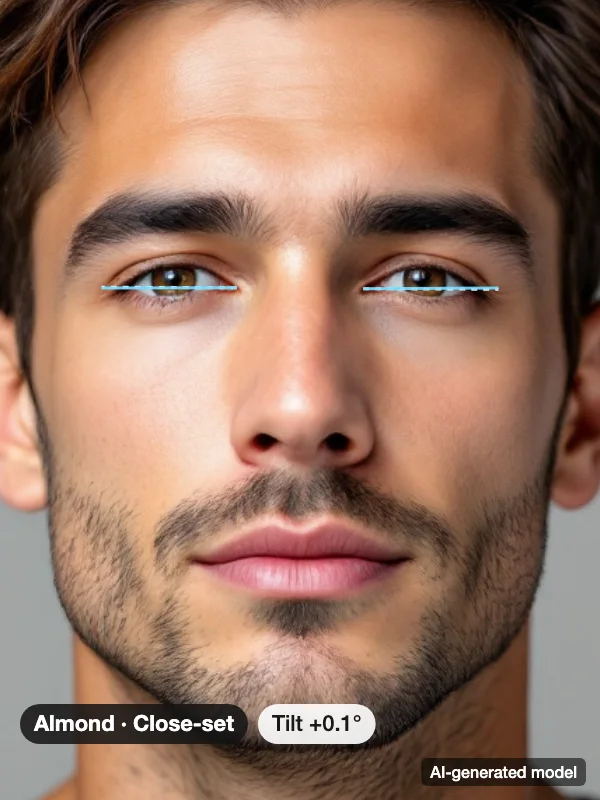
The detector at the top of this page turns the first sign into a number. It maps 478 points on your face in your browser and divides the height of each eye opening by its width. Below 0.30, the opening reads as almond; at 0.30 or more, it reads as round. Typical eyes measure between about 0.22 and 0.32, with an average near 0.26, which puts the average eye on the almond side of the line. The cut-offs are drafts, still being tuned on annotated photos, so a result near 0.30 is marked as close to the line.
Do I have almond eyes? A closer check
A mirror gets you most of the way. Stand at arm's length in even light, look straight ahead, and let your face go slack. Raised brows make the opening taller and a smile makes it narrower, so both give a wrong answer.
Now look at the iris, the colored ring. On almond-shaped eyes the upper lid covers its top edge and the lower lid touches its bottom edge. If you can see white under the iris while you look straight ahead, the opening is taller, and round is the better description.
A photo gives you a number to go with the impression. Hold the camera at eye level, an arm's length away, and take a straight-on shot. Zoom in on one eye and compare the height of the opening at its tallest point with the width from corner to corner. If the height is less than a third of the width, you are on the almond side.
The scanner does the same thing with more care. It measures both eyes, corrects for a head tilted toward one shoulder, and reports the result as a line such as "almond" or "almond, upturned", with the three numbers behind it. It offers two openings only, almond and round, so a very narrow opening, the kind sometimes called thin almond eyes, also reads as almond.
Almond or round: what the difference means
Put almond eyes vs round eyes side by side and they turn out to be the two ends of one measurement, with a border that is a matter of a few hundredths. An opening of 0.29 and one of 0.31 look nearly the same in the mirror, yet the first is called almond and the second round. If your reading is close to 0.30, think of your eyes as a bit of both and use the styling ideas for either. Openings just under the line are what people mean by round almond eyes. Doe eyes vs almond eyes is the same contrast under another name: "doe eyes" is an informal term for large, wide-open eyes, which sit on the round side of the measurement.
The practical difference is where each shape already has length. An almond opening is long, so liner and shadow mostly follow what is there. A round opening is tall, so the usual advice is to add length: extend the liner past the outer corner and keep it thin at the inner corner. Makeup changes the impression, not the measurement, which is why the scanner asks for a bare, relaxed eye.
Can almond eyes be hooded, upturned or downturned?
Yes, because those words describe different things. Almond is about the opening. Upturned and downturned are about the line from the inner corner to the outer corner: the detector calls eyes upturned when the outer corner sits 5° or more above the inner one, and downturned when it sits more than 1° below. Close-set and wide-set are about the gap between the eyes. A result can read "almond, upturned" or "almond, wide-set", so upturned almond eyes and downturned almond eyes are both ordinary combinations. The eye shape detector page explains each label. The corner line has its own page too: canthal tilt.
Hooded almond eyes and deep set almond eyes are common as well. Hooded and monolid describe the eyelid, and deep-set describes how far back the eye sits. None of the three shows reliably in a front photo, where a fold of skin and the depth of the socket are flattened. The scanner leaves them out on purpose. A mirror answers them better: open your eyes, look straight ahead, and see whether a crease is visible above the lashes.
Eyeliner for almond eyes
This is the easy case for liner, since the opening already has length and a taper. A thin line along the upper lashes with a small flick follows the natural corner, which is why winged eyeliner for almond eyes takes so little correcting. Draw the flick in the direction your lower lash line would take if it kept going, and stop before it gets longer than the corner itself.
From there, liner is a way to lean the shape one way or the other. A line that is thicker over the center of the eye makes the opening read taller and rounder. A longer, flatter wing stretches it. Lining only the outer third keeps the inner corner open, which helps when your eyes also read as close-set. All four shapes are drawn, step by step, in the guide to eyeliner for almond eyes.
Eyeshadow and makeup for almond eyes
Eyeshadow for almond eyes follows the same logic as liner. A deeper shade on the outer third echoes the taper; a lighter shade on the center of the lid adds height. A soft line of shadow under the outer lower lashes lengthens the eye a little more, and leaving the inner corner bare keeps it open.
None of this is a rule. The opening already carries most shapes, so treat the usual advice as a way to choose a direction: longer, rounder or just as it is. Check any look with your eyes open and relaxed, because that is how it will be seen.
Lashes, brows and glasses for almond eyes
Lashes that get longer toward the outer corner follow the outline of the eye, and a lash map for almond eyes usually puts its longest lengths on the outer third for that reason. Lashes of even length, or longest at the center, open the eye and soften the taper. Neither is the correct one; pick the effect you want that day. If a curler pinches at the corners, try one with a flatter curve, which tends to sit better against a long, shallow lash line.
For brows, follow your natural arch and keep the tail in line with the outer corner of the eye. A tail that drops below that line pulls the corner down with it.
Glasses are simple as well. Most frame shapes work with an almond opening, so choose by the face instead: match the frame width to the width of your face. The guide to glasses for face shape shows the frames that suit each of the seven face shapes.
Are almond eyes rare?
Almond eyes are common. By the detector's numbers they are the usual case: the average opening is about 0.26 of the eye's width, and the line for round starts at 0.30. What varies more from person to person is everything around the opening, such as the tilt, the spacing and the eyelid, and that is why two people with almond-shaped eyes can look quite different.
It also means the label is not a ranking. An eye shape is a description that helps you choose a liner or a frame, and the scanner reports it as a measurement with no score attached.
Why two photos can give two answers
An eye opening is a few millimeters tall, so small things move the number. Squinting in bright light narrows it. Surprise, raised brows and a wide smile change it. A camera held below eye level shortens the visible opening, and a lens that is too close distorts the whole face. The scanner rejects photos with a strong expression or closed eyes, and it measures the corner line against your face's own horizontal, so a tilted head does not change the tilt reading.
For a steady result, use soft light from the front, hold the camera at eye level about 3 feet away, and take glasses off. If two photos still disagree, your opening is probably near the line, and "a bit of both" is the honest answer. To see the same eyes in the context of the whole face, the face analysis page reads the proportions of the face from one photo, and the face shape detector gives your face shape.
Updated 2026-10-06