What are round eyes?
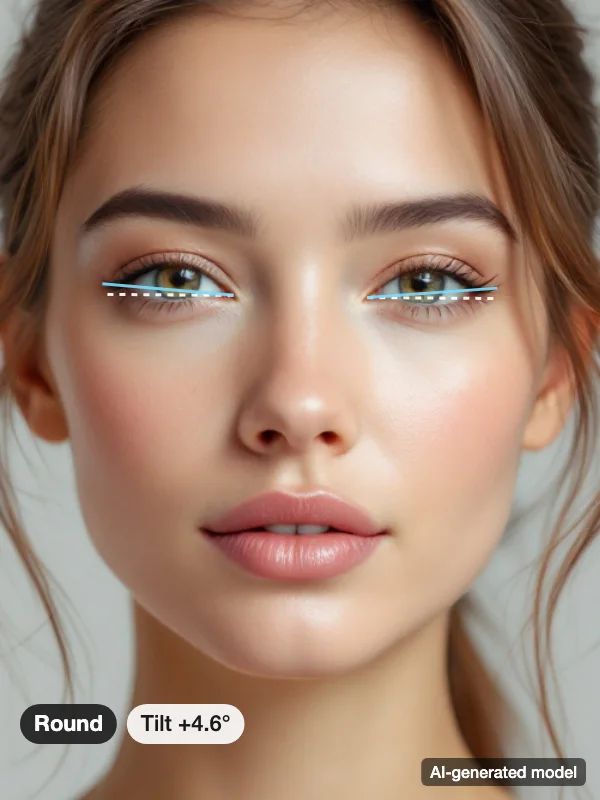
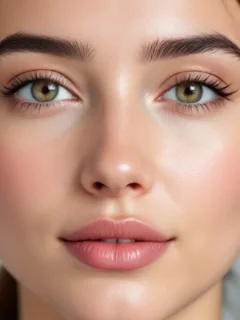
Round eyes are eyes whose opening is tall for its width. The lids curve away from the iris instead of resting on it, so the colored part of the eye is fully visible and a thin strip of white often shows underneath. The corners look soft and open instead of narrowing to a point. That is the whole definition: it describes the gap between the lids, not the size of the eye, its color or the eyelid above it.
The detector at the top of this page puts a number on it. It maps 478 points on your face in your browser and divides the height of each eye opening by its width. At 0.30 or more, the result reads as round; under 0.30, it reads as almond. Typical eyes measure between about 0.22 and 0.32, and the average is near 0.26, so round covers the taller end of an ordinary range. The cut-offs are drafts that are still being tuned on annotated photos, which is why a reading near 0.30 is flagged as close to the line.
Do I have round eyes? What to look for
Start with a mirror at eye level and a relaxed face. Look straight ahead, not up, and find the lower edge of the iris. On a round eye shape there is usually a sliver of white between the iris and the lower lid, and the upper lid sits at or just above the top of the iris. If both lids overlap the iris, the opening is flatter than it looks and almond is the closer word.
Expression matters more here than for any other eye shape. Lifting the brows, opening the eyes for a photo or looking up at a phone all make the opening taller, and can push an almond eye over the line for one picture. A wide smile does the opposite. For an honest answer, let your face settle for a second before you look or shoot.
If you want a number, zoom in on a straight-on photo and compare the tallest part of the opening with the distance from corner to corner. A height close to a third of the width, or more, puts you on the round side. The scanner measures both eyes the same way, corrects for a head that leans toward one shoulder and gives the result as a line such as "round" or "round, upturned", with the numbers behind it.
Round eyes or just big eyes?
Size and shape are easy to mix up. "Big eyes" is about how much room the eyes take up on the face; round eyes are about the proportion of one opening. A small eye can be round and a large eye can be almond. "Doe eyes" is an informal name for large, wide-open eyes, and it usually lands on the round side of the measurement, but it is a look, not a category the scanner reports.
Roundness is also separate from the eyelid and from depth. Hooded, monolid and deep-set describe a fold of skin or how far back the eye sits, and a front photo flattens both, so the scanner does not classify them. Round shaped eyes can come with any of the three. The eye shape detector page lists what a selfie can and cannot show.
Eyeliner for round eyes
The usual aim of eyeliner for round eyes is length, because the opening already has height. Three things do most of the work:
- Start thin. Keep the line as fine as you can over the inner third, so the inner corner stays open.
- Carry it out. Let the line thicken slightly over the outer third and take it a few millimeters past the outer corner, level or rising only a little.
- Keep the center flat. A line that is thickest over the middle of the eye adds height, which is the opposite of the plan.
On the lower lash line, a soft shadow under the outer third stretches the shape; lining all the way around closes it in and makes it read rounder. If roundness is what you like, do exactly that: a thicker center and a full lower line. None of this changes the measurement. It changes the impression, which is the point of liner.
Eyeshadow and makeup for round eyes
Makeup for round eyes follows the same idea in a softer form. Blend a deeper shade outward from the outer third toward the tail of the brow, in a shape that is wider than it is tall, and keep the lightest shade at the inner corner. A shadow that climbs straight up from the center of the lid toward the brow makes the eye read taller.
Lashes work the same way. Extra length at the outer corners pulls the eye sideways, while even length across the lid, or the longest lashes in the center, keeps the open, round look. Mascara on the lower lashes makes the opening look taller.
Brows and glasses for round eyes
A soft, angled arch adds length above a round eye, where a very curved brow repeats the curve of the opening. Keep the tail of the brow in line with the outer corner or slightly above it.
For glasses, frames that are slightly wider than they are tall, with a gentle upswept corner, echo the liner advice: more width than height. Very round lenses repeat the shape of the eye. Frame width should still follow the face, so the glasses for face shape guide is the better place to pick a size.
When round eyes come with a tilt or a spacing label
Round is only the first word of the result. The scanner also reads the line from the inner corner to the outer corner and the gap between the eyes, so a result can say "round, upturned" or "round, close-set". Corners that sit 5° or more above the inner corners read as upturned eyes, and corners more than 1° below read as downturned eyes. When a second label appears, combine the tips: lengthen for round, then follow the note for the tilt or the spacing.
If your opening reads under the line instead, the almond eyes page covers the same ground from the other side.
Why the same eyes can read round one day and almond the next
An eye opening is only a few millimeters tall, so small changes move the ratio. Bright light makes you squint. A camera held below your face hides part of the opening behind the lower lid, and one held too close distorts everything. Tired eyes open less. The scanner rejects photos with closed eyes or a strong expression, but it cannot know how relaxed you were.
Use soft light from the front, hold the camera at eye level about 3 feet away and take your glasses off. If two careful photos still disagree, your eyes are near 0.30, and "a bit of both" is the accurate description. For the rest of the face, the face shape detector reads your face shape from the same photo.
Updated 2026-10-06