What a typical attractiveness test does
Most online attractiveness tests work the same way: you upload a photo, and the site returns a single rating, sometimes with a label. An AI attractiveness test often learns from photos that other people have rated, so its number reflects those raters' tastes, the photos it learned from, and the light and angle of your picture. This attractiveness test takes a different route. It measures the geometry of your face, explains every number, and leaves attractiveness itself to people, not to a formula.
Why one photo can't measure attractiveness
Attractiveness is not a property you can read off a picture, for several reasons:
- It is subjective. People looking at the same face often disagree.
- It is cultural. Tastes differ between cultures and shift over time.
- It moves. Expression, voice, warmth and the way someone laughs matter in real life, and a still photo catches little of that.
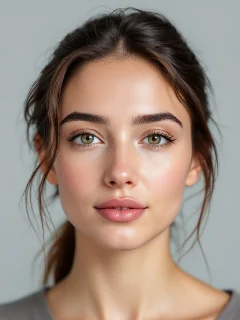
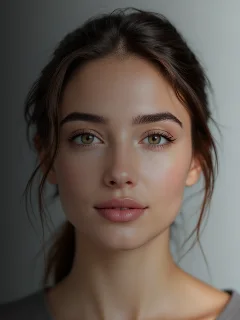
- It depends on the photo. Lighting, lens distance, angle, grooming and styling can make the same face come across very differently from one picture to the next.
- It depends on context. Who is looking, and where, changes the impression.
A single rating would mostly describe one photo, taken on one day, judged against one set of assumptions.
AI attractiveness test apps: what they actually score
Many AI attractiveness test apps start from the same recipe. Someone gathers a large set of face photos, asks people to rate each one, and trains a model to predict those ratings from the image. When you upload a selfie, the app returns its guess at how that particular group of raters would have scored that particular picture.
That makes the number a reflection of three things more than of your face:
- The training data. A model only knows the photos it learned from. If they came from a narrow range of people, ages or photo styles, its ratings carry that narrowness with them.
- The photo conditions. Light, lens distance, camera angle, image quality, expression and makeup all change the pixels the model reads, so two photos of the same face can come back with different numbers.
- The raters' tastes. Each rating stands for the average opinion of particular people, gathered at one time and in one place. A different group of raters would have trained a different model.
Before trusting a rating from any app, ask who rated the training photos, how many people took part, and what kinds of photos they saw. If the app doesn't say, the number is hard to interpret. This page works the other way round: every number it shows is a named distance or ratio that you can trace back to points on your own photo.
What this attractiveness face test measures instead
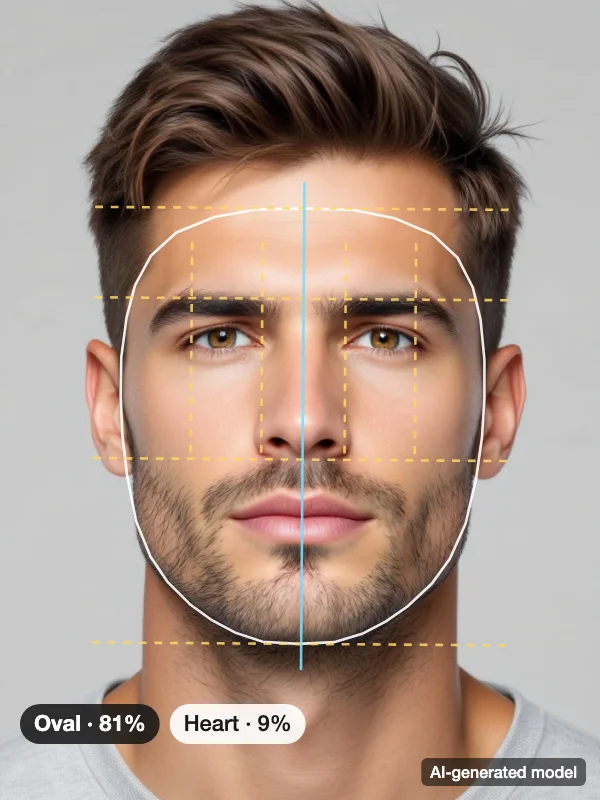
This attractiveness face test maps 478 points on your face with Google's MediaPipe Face Landmarker, inside your browser, and measures the distances between them. You get your face shape, three core measurements and a Harmony Score: one number, shown on a 40–98 range, that summarizes how six proportions sit relative to reference values.
- Facial thirds: how the height of the lower face compares with the mid-face. The forehead third is shown in your result but left out of the score, because hair can hide the hairline.
- Facial fifths: the width of each eye compared with the gap between the eyes.
- Left–right symmetry: how closely mirrored points match, explained on the face symmetry test page.
- Eye spacing: the distance between the pupils relative to face width. The reference, near 46%, comes from a 2010 study by researchers Pallett, Link and Lee on viewer-preferred spacing in face images.
- Eye-to-mouth distance: relative to face length, with a reference near 36% of the hairline-to-chin length, from the same study.
- Golden-ratio closeness: six classic ratios compared with 1.618, given a low weight. The golden ratio face calculator explains all six.
For a closer look at these proportions, from facial thirds to eye spacing, see the face analysis page.
What it does not measure
The Harmony Score measures geometry only. It does not measure attractiveness, skin, expression, style, grooming or personality, and it does not predict how others see you. Two people with the same score can look nothing alike, and the same person can score a little differently in two photos.
The tool also does no face recognition, no identity or look-alike matching, and no estimation of age, gender, emotion or ethnicity. Your numbers are compared with fixed reference values, never with other people.
What research says, carefully
Researchers have studied two features of faces for decades: symmetry, and averageness, which means how close a face is to the average of many faces. Some studies find that viewers slightly prefer more symmetric or more average faces in controlled images. The effects are modest, they vary between studies and populations, and they are only part of why people find someone appealing.
This tool measures symmetry but not averageness, and it does not turn either into a verdict. Treat the research as background, not as a scoring rule.
How to use your attractiveness test result
The numbers are most useful as a description you can act on:
- Photos. Retake at about 3 feet (1 meter) in even light and compare. The full report also suggests a camera side to try, based on your symmetry measurements.
- Styling. Your face shape and proportions point to hairstyles, glasses frames, beard styles, makeup, necklines, earrings and hats that suit them. For example, a face that measures clearly longer than it is wide often suits side volume, bangs and taller frames; the oblong face shape page has more.
- Context, not a target. If a number sits outside a reference range, that describes your face. It is not something to fix.
Adults only, and private by design
This attractiveness test is for adults 18 and over. You confirm your age before you scan, and the tool never estimates age from the photo.
The scan runs entirely in your browser, and the photo you scan is never uploaded. Your result stays in this browser for 24 hours unless you clear it sooner, and a share link carries only your numbers, never your photo. If you buy the full report ($12.99, one-time, no subscription), only derived ratios are sent to the server. If face shape is all you want, start with the face shape detector.
Updated 2026-09-26