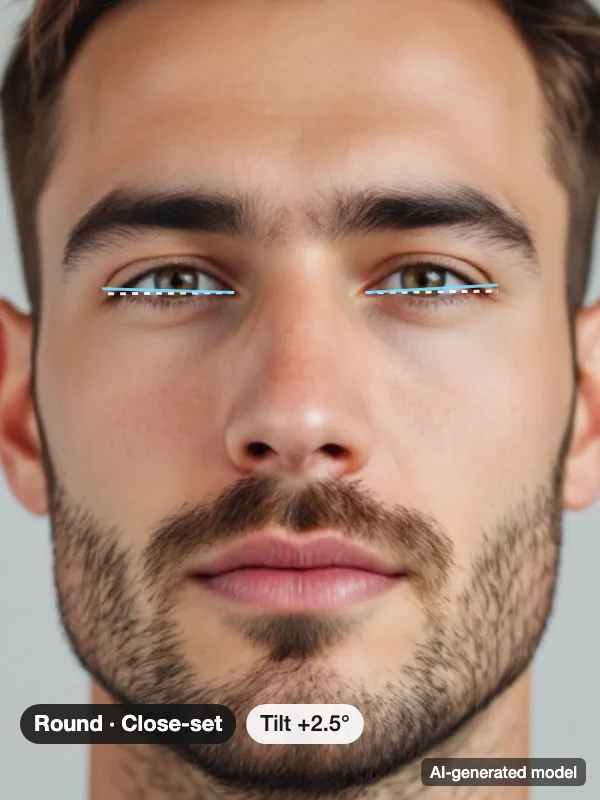
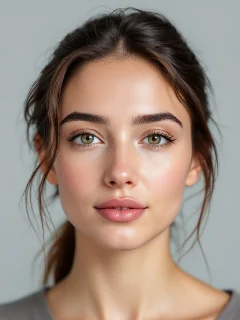
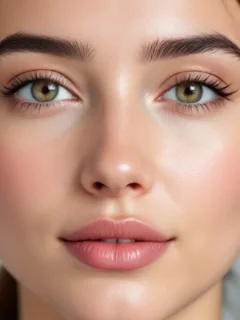
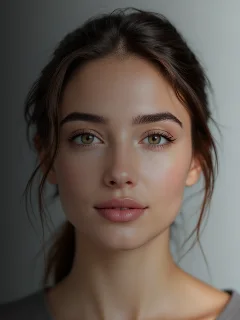
What are close-set eyes?
Close-set eyes are eyes that sit nearer to each other, and to the bridge of the nose, than the usual proportion. The classic drawing rule says a face is about five eye widths across, with one eye width between the eyes. When the gap is clearly smaller than one eye, the eyes are called close-set. It is a statement about spacing only: the eyes themselves can be any size and any shape.
The scanner on this page measures the same thing from a selfie, with one difference you should know about. It divides the gap between the inner corners by the width of the eye, using the corner points it maps on the photo, and on those points the gap comes out larger than the drawing rule suggests. The average face reads about 1.43, and the usual range runs from 1.25 to 1.6. A reading under 1.25 is shown as close-set, and one over 1.6 as wide-set. So read the scanner's number against the scanner's range, and use the one-eye rule only when you measure by hand. The cut-offs are drafts, still being tuned on annotated photos.
How to check for close-set eyes by hand
You need a straight-on photo, because a mirror keeps you too close and a turned head ruins the comparison. Stand about 3 feet from the camera, hold it at eye level and face the lens squarely. Turning the head even a little shortens the eye that is farther away and narrows the gap.
Measure one eye from its inner corner to its outer corner. Then measure the gap between the two inner corners. A gap that matches the eye is average spacing. A gap noticeably smaller than the eye points to close-set eyes, and a larger one to wide-set eyes. That is all there is to close-set vs wide-set eyes: the same two measurements, read in opposite directions. Differences of a millimeter or two on a phone screen are not worth arguing with; this is a rough check.
The scanner does the same comparison on both eyes, uses the average eye width and flags a result that sits close to its cut-off. Because it works with a ratio, the size of the photo and the size of your face do not change the answer. What does change it is a lens held too close, which stretches the middle of the face and makes the gap look larger than it is.
What can make eyes look close-set
Spacing is easy to misjudge, because the eye reads it against whatever is nearby. A narrow nose bridge, brows that start close together, or a deep shadow at the inner corners all make the gap look smaller than it measures. Glasses with a dark, heavy bridge fill the space in the same way. Long hair worn forward at the sides narrows the face and has a similar effect.
The reverse is also true, which is good news if you want to change the impression: light at the inner corners, a little more room between the brows and an open frame bridge all make the same eyes look farther apart. None of it moves the measurement. It moves the impression, and that is what the tips below are for.
Makeup for close-set eyes
Makeup for close-set eyes works by putting light at the center of the face and depth at the edges.
- Inner half of the lid: a lighter shade, with the palest point right at the inner corner.
- Outer half: a deeper shade, blended outward past the outer corner instead of inward.
- Eyeliner: start above the iris, or even above its outer edge, and thicken the line toward the outer corner. A small flick carries the eye outward.
- Lashes: concentrate mascara and length on the outer half.
Eyeliner for close-set eyes follows the same rule as the shadow. The one thing to avoid is dark liner or shadow that wraps around the inner corner, since it draws the two eyes together. If you line the lower lashes, keep it to the outer third.
Brows and glasses for close-set eyes
Brows frame the gap, so where they begin matters. Start them in line with the inner corners of the eyes or slightly outside, and remove stray hairs between them. A brow that starts closer to the nose than the eye does narrows the space. Extending the tail a little outward adds width at the other end.
For glasses, a clear or light-colored bridge keeps the space between the eyes open, and frames with color or detail at the outer edges draw attention outward. Choose the frame width by your face: the glasses for face shape guide lists frames for each of the seven face shapes.
Close-set eyes with other eye shape labels
Spacing is the last word of a result. The scanner names the opening first, almond or round, then the corner line if it is not level, then the spacing: "almond, close-set" or "round, upturned, close-set". Each part has its own tip, and they stack without conflict. For example, on almond eyes that are also close-set, liner on the outer third alone keeps the inner corner open.
For a tilt label, see upturned eyes or downturned eyes. The eye shape detector page shows all the labels on one chart.
Why the spacing number can shift
Three things move the reading from photo to photo: a head turned to one side, a lens held too close, and squinting, which shortens the visible eye. The scanner rejects photos where the head is turned too far, but a small turn still gets through. For a steady number, face the lens squarely in even light, hold the camera about 3 feet away at eye level and keep your face relaxed. If two careful photos land on either side of 1.25, your spacing sits at the edge of average, and both descriptions are fair.
Updated 2026-10-06