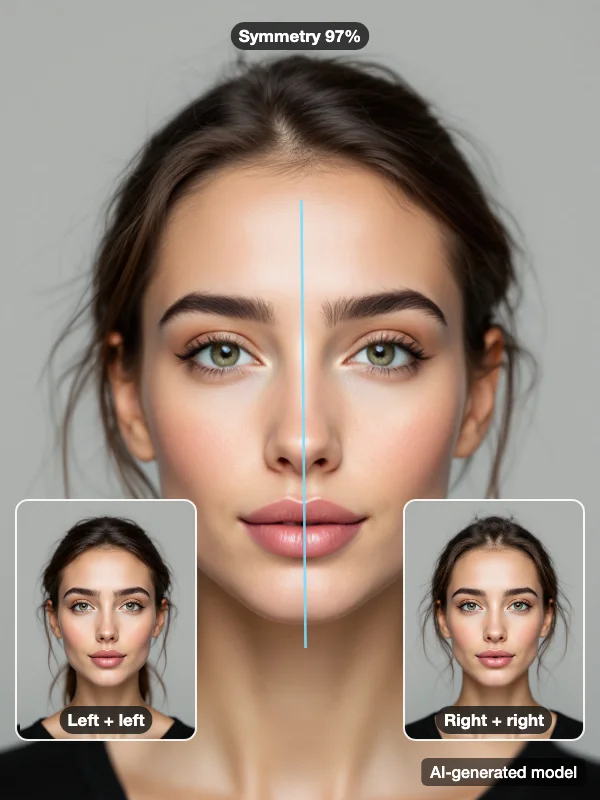



How the face symmetry test works
This face symmetry test compares the two sides of your face point by point. Google's MediaPipe Face Landmarker maps 478 points across your face in your browser, and many of them come in matched pairs: the outer corners of the eyes, the ends of the brows, the edges of the nose and mouth, and points along each side of the jaw.
The test finds the midline of your face, mirrors each point from one side across it, and measures how far the mirrored point lands from its partner on the other side. Those gaps are averaged and measured relative to your face width, so the result does not depend on how large your face appears in the photo.
How to read your facial symmetry test result
Overall symmetry is 100% minus the average mismatch, scaled so that a mismatch of 10% of your face width would score 0. In practice:
- 100% would mean every mirrored point lands exactly on its partner.
- Every 10 points below that stands for an average mismatch of 1% of your face width.
- 90%, for example, means the points are off by 1% on average. On a face about 5.5 inches (14 cm) wide, that is roughly 1.4 mm, less than a sixteenth of an inch.
The number describes the geometry of one photo. It is not a grade, and there is no score to aim for. Symmetry is also one of six parts of the Harmony Score, which the attractiveness test page explains.
Why nobody's face is perfectly symmetric
Everyone has some asymmetry. One eye may sit a little higher or look a little more open, one brow may arch more, the nose tip may lean slightly to one side, and a smile often lifts one corner of the mouth more than the other. Small differences like these are normal.
Measured face symmetry also shifts from photo to photo with pose, expression, lighting and the camera lens. That is why a face symmetry test describes one photo at a time rather than a fixed trait.
You may have seen symmetry face filters that build a whole face from two copies of one side. Those composites often look unfamiliar, which is a good reminder that real faces are not mirror images. This test does something different: it measures your actual left and right sides and shows how closely they match.
What affects a face symmetry test result
Because the test compares small distances, the photo matters. The main influences:
- Head pose. Turning your head even slightly brings one side closer to the camera, and tilting it moves points up on one side.
- Expression. A smile, a raised brow or a squint is rarely even on both sides.
- Lens distance. Up close, a front camera enlarges whatever is nearest the lens. Stand about 3 feet (1 meter) away.
- Lighting. A strong shadow on one side makes landmarks harder to place there.
- Hair. A side part, or hair falling over one side of the forehead or jaw, can hide the edges the test measures.
- Mirror flip. Mirror selfies swap left and right, so the camera-side tip will point to the opposite side.
Regional breakdown and your camera side
The free result shows your overall symmetry. The full report ($12.99, one-time) breaks it down into five regions: eyes, brows, nose, mouth and jaw, so you can see which areas match most closely and which least. It also shows how far your nose tip and chin sit from the midline.
The report adds a camera-side tip. If one side measured a little more open at the eye or a little higher at the mouth corner, it may photograph more evenly, so the report suggests turning that side about 15 degrees toward the camera, with the main light on that side. It is a suggestion to try, not a judgment: take one shot of each side and keep the one you prefer. If both sides measure alike, the report says so, and either side works.
How to retake for a fair comparison
To compare two results, change as little as possible between them:
- Use the same spot, the same light and the same camera, about 3 feet (1 meter) away.
- Face the camera straight on, eyes level, chin neither raised nor lowered.
- Keep a neutral expression: eyes open, mouth closed, no smile.
- Take off your glasses and push your hair back so both sides of your forehead and jaw show.
- Check whether your camera saves mirrored photos, and stick with one setting.
Comparing two face symmetry test scores
Once you have two photos taken the same way, a few habits keep the comparison honest:
- Expect a little movement. A difference of 1 to 3 points between two careful photos is normal. It comes from tiny changes in head angle, expression and light, not from any change in your face.
- Check the setup before the number. If the score moves by more than that, look for what changed: a slight turn of the head, a half smile, hair over one side, a different light, or a mirrored photo. Fix it and retake before reading anything into the result.
- Take a few shots in a row. Three photos give you a range, and the middle value is a steadier guide than any single scan.
- Compare like with like. A face symmetry test score from a front camera held close and one from a phone propped up about 3 feet away are measuring slightly different geometry, because the lens changes how each side of the face projects.
If you have the full report, compare the five regions as well. When one region jumps while the others hold steady, the cause is often hair, expression or a shadow in that part of the face.
Your scan also shows your face shape, which the face shape detector explains, and the golden ratio face calculator covers six classic proportions. To see symmetry next to your other measurements, such as facial thirds and eye spacing, try face analysis. Your result stays in this browser for 24 hours, and the photo you scan never leaves your device.
Updated 2026-09-26