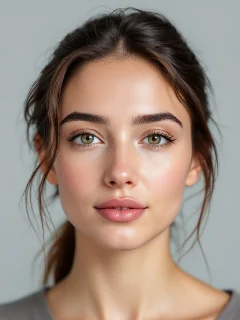
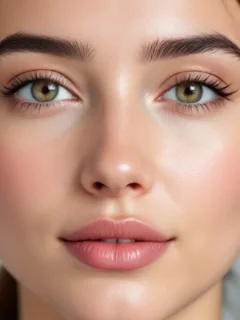
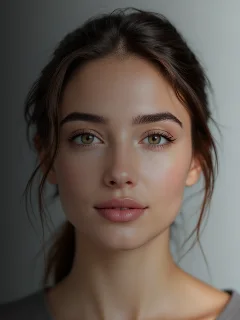
What are downturned eyes?
Downturned eyes are eyes whose outer corners sit slightly lower than the inner corners. Follow the lash line from the nose outward and it slopes gently down at the end instead of running level. The slope is usually small, a few degrees at most, and it says nothing about how open the eye is, how large it is or how far apart the eyes sit.
On this page the slope is a measurement. The detector maps 478 points on your face in your browser, picks out the inner and outer corner of each eye and measures the angle of the line between them against the horizontal of your own face. When the outer corner sits more than 1° below the inner corner, the result reads as downturned. From 1° below level to 5° above, the corners read as level, and 5° or more above reads as upturned. Those cut-offs are drafts, still being tuned on annotated photos, and a reading near one of them is marked as close to the line.
Do I have downturned eyes? Check the photo, not the mirror
In a mirror you look slightly down or up at yourself, and that changes where the corners appear to sit. A straight-on photo is fairer. Keep the camera at the height of your eyes, stand about 3 feet away, hold your head upright and relax your face before you take it.
On the photo, connect the two inner corners with the edge of a card. If both outer corners sit below the edge, you are looking at downturned eyes. If one sits below and the other on the line, look at the head first: a slight lean toward one shoulder drops one eye in the picture. The scanner measures against the face's own horizontal, so that lean does not affect its reading, and it reports one angle based on both eyes, with the line of each eye drawn on your photo.
Camera height matters more than anything else. A phone held below the face, looking up, lowers the outer corners in the picture, because they sit farther back on the head than the inner corners. A phone held high does the reverse. If your result changes between two photos, check where the lens was.
Downturned eyes, hooded lids and tired days
Three things are often mistaken for a downturned eye shape. The first is a hooded lid: a fold of skin that hangs lower toward the outer edge and hides the corner behind it. The corner itself may be level. The second is the brow. A brow tail that drops below the start of the brow draws the whole eye area downward without moving the corner. The third is simply the time of day, because eyes open less when they are tired and the outer part of the upper lid sits lower.
The scanner aims at the two corner points and ignores the brow. A heavy fold over the outer corner can still hide the point it is looking for, and it cannot tell you whether a lid is hooded at all, since a front photo flattens the fold. If your result and the mirror disagree, one of these three is probably the reason. The eye shape detector page explains what one selfie can and cannot show.
Downturned eyes and negative canthal tilt
The angle of the corner line is also called the canthal tilt. On the canthal tilt page, an outer corner more than 1° below the inner corner is called a negative tilt; here the same reading is called downturned. One line, two vocabularies.
Both are descriptions. The usual range of corner angles runs from about 2° below level to 6° above, so a reading just under the line is an everyday angle that happens to fall on the lower side. Nothing about it needs correcting, and the result carries no score. What the label is good for is choosing where to put liner and which frames to try.
Eyeliner for downturned eyes
Eyeliner for downturned eyes has one job: carry the eye upward at the outer corner. The steps are short.
- Draw a thin line along the upper lashes from the inner corner outward.
- Stop following the lash line a few millimeters before the outer corner, where it starts to drop.
- From that point, angle the flick slightly upward, toward the tail of the brow, and keep it short.
- Fill the small gap between the flick and the lashes, so the wing looks solid with your eyes open.
Leave the outer part of the lower lash line bare. Liner or dark shadow there adds weight under the corner and pulls it down again. If you like definition below the eye, keep it to the inner half, or use a light, skin-toned pencil on the outer part.
Eyeshadow and makeup for downturned eyes
Makeup for downturned eyes uses the same direction as the liner. Place the deepest shadow on the outer third of the upper lid and blend it up and out toward the end of the brow, stopping at an imaginary line from the outer corner to the brow tail. Shadow that spills below that line drags the shape down.
Curl the outer lashes and put most of the mascara there, since lashes that fan upward at the corner lift it. A lighter shade at the inner corner and under the arch of the brow finishes the effect without adding weight.
Brows and glasses for downturned eyes
Keep the tail of the brow level with or above the point where the brow starts. A tail that ends lower repeats the slope of the eye, and filling it a few millimeters higher changes the whole impression more than any liner.
Frames do the same work with less effort. Cat-eye or upswept shapes lift the outer edge, while frames whose outer corners droop repeat the slope. Width still depends on your face, so start from the glasses for face shape guide and then pick the upswept version of what it suggests.
Downturned eyes with other labels
Downturned is never the first word of a result. The scanner names the opening first, almond or round, and adds the tilt and the spacing when they fall outside the middle band, as in "almond, downturned" or "round, downturned, close-set". Use each tip for its own part: the almond eyes and round eyes pages cover the opening, and the opposite corner line is on the upturned eyes page.
Updated 2026-10-06