
How to tell what eye shape you have
If you have ever leaned into a mirror and asked, "What is my eye shape?", you have probably found that eye shape charts make it look simpler than it is. Eyes are small, they move, and most people have a mix of traits. This eye shape detector answers with measurements instead of guesswork. It maps 478 points on your face with MediaPipe Face Landmarker, right in your browser, and reads the three things that make up your eye shape:
- Opening: eye height divided by eye width. At 0.30 or more, eyes read as round; below that, almond. Typical eyes measure between about 0.22 and 0.32, with an average near 0.26.
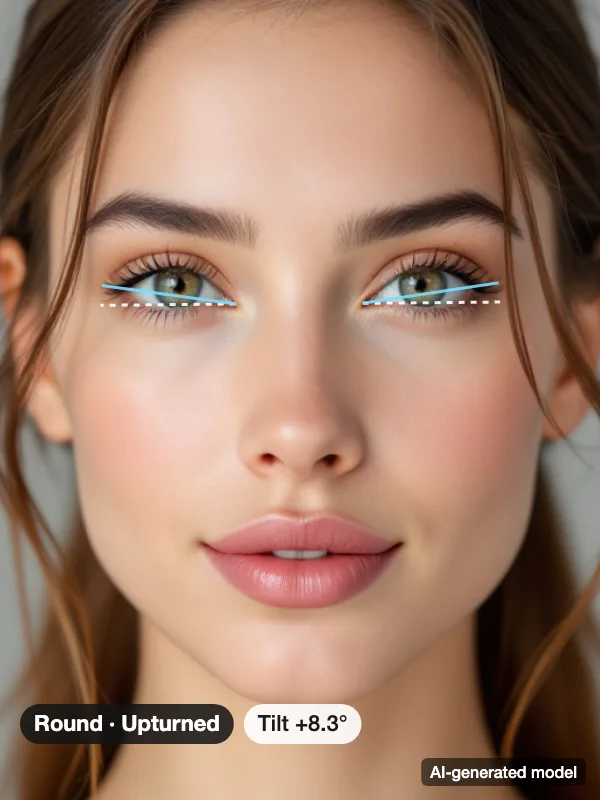
- Corner tilt: the angle of the line from the inner corner to the outer corner, measured against your face's own horizontal, so tilting your head toward one shoulder does not change it. At +5° or more, eyes read as upturned; below −1°, downturned; anything in between is straight.
- Spacing: the gap between the inner corners, divided by the width of one eye. Below 1.25 the eyes read as close-set, and above 1.6 as wide-set. The average is about 1.43.
These eye shape cut-offs are drafts, still being tuned on annotated photos. When one of your numbers sits close to a cut-off, the result tells you, because lighting or expression could tip it either way.
You can also answer "what eye shape do I have?" without the scanner, as a rough cross-check. Take a straight-on photo, zoom in, and look for the same three things: whether the opening looks tall and open or long and narrow, whether a line from the inner to the outer corner runs up, level or down, and whether the gap between your eyes looks shorter or longer than one eye. Angles of a few degrees are hard to judge by eye, so treat a hand check as a first impression rather than a measurement.
Types of eye shapes: an eye shape chart
Most lists of the types of eye shapes mix three different things: the outline of the opening, the direction of the corner line and the space between the eyes. This eye shape chart keeps them apart, because the eye shape detector gives you one reading from each group. Your eyes can be almond, upturned and wide-set all at once.
Almond
Longer than tall, with an opening under 0.30 of the width.
Round
A taller opening: 0.30 of the width or more.
Upturned
Outer corners 5° or more above the inner corners.
Downturned
Outer corners more than 1° below the inner corners.
Close-set
Gap between the eyes under 1.25 eye widths.
Wide-set
Gap between the eyes over 1.6 eye widths.
- Almond: longer than tall, with the lids narrowing toward both corners. The opening measures under 0.30 of the eye's width.
- Round: a taller opening, often with more of the iris showing, at 0.30 of the width or more.
- Upturned: the outer corners sit 5° or more above the inner corners, so the eye line rises toward the temples.
- Downturned: the outer corners sit more than 1° below the inner corners, so the eye line slopes gently down.
- Close-set: the gap between the eyes is under 1.25 eye widths, so the eyes sit nearer the bridge of the nose.
- Wide-set: the gap between the eyes is over 1.6 eye widths, leaving more space across the bridge.
Straight tilt and average spacing are the middle bands, so the summary line leaves them out. Every eye shape result names an opening, almond or round, and adds a tilt or spacing label only when yours falls outside the middle band. A plain "almond" eye shape simply means straight corners and average spacing.
What is my eye shape? Reading your result
The result answers "what is my eye shape?" in one line, such as "almond, upturned", and then shows the three numbers behind it:
- Opening: your height-to-width ratio, with almond or round.
- Corner tilt: the angle in degrees, based on both eyes, with upturned, straight or downturned. The corner line of each eye is drawn on your photo, on your device, so you can see exactly which line was measured.
- Spacing: the gap between your eyes in eye widths, with close-set, average spacing or wide-set.
Read the numbers along with the eye shape labels. An opening of 0.29 and one of 0.31 look almost the same, yet the first reads almond and the second round, so a result near a cut-off means "a bit of both" more than "one or the other". If a reading lands close to a line, take a second photo the same way and see where it settles.
The corner angle has a page of its own. A scan started on the canthal tilt page lists each eye's angle in degrees, and that page explains why the angle moves between photos. It also sorts the angle into finer bands: positive above +1°, neutral from −1° to +1°, negative below −1°. That is why an eye at +3° counts as positive there and straight here. Both pages describe the same line; they group the numbers differently.
Makeup, brows and glasses for each eye shape
These are the same tips your result shows for each eye shape label. They follow the lines of each eye shape, and they are options rather than rules: use them to echo your natural eye shape, or skip them on days you want a different look.
- Almond: most liner shapes work, and a thin line with a small flick follows the natural corner. Follow your natural brow arch and keep the tail in line with the outer corner of the eye. Most frame shapes work too; match the frame width to your face width.
- Round: extend the liner past the outer corner and keep it thin at the inner corner to lengthen the eye. A soft, angled brow arch adds length above it. Choose frames slightly wider than they are tall, with a gentle upswept corner.
- Upturned: a little shadow along the outer lower lash line balances the lift. A straighter brow keeps the lift from doubling up. Straight or softly rounded frame tops sit calmly with the angle.
- Downturned: angle the flick slightly upward and keep liner off the outer lower lash line. Keep the brow tail level with or above the start of the brow. Cat-eye or upswept frames lift the outer edge.
- Close-set: use a lighter shade on the inner half of the lid and a deeper one on the outer half. Start the brows in line with the inner corners of the eyes, or slightly outside them. A clear or light-colored bridge keeps the space between the eyes open.
- Wide-set: bring a deeper shade toward the inner corner and take the liner all the way in. Let the brows start a little closer to the nose. A darker or keyhole bridge draws the eyes toward the center.
When your eye shape result combines labels, such as round and downturned, it shows the tips for each one, and you can combine them. To compare two looks, photograph each in the same light and from the same distance, then keep the one you like.
What one photo can't tell: hooded, monolid and deep-set eyes
Three common eye descriptions depend on the eyelid and on depth, and a front photo flattens both. The detector measures the outline of the opening, its corner line and the spacing, so it does not classify these three. A mirror does the job better, and each of them can come with any eye shape above. The answer to "what is my eye shape?" might be almond and upturned, with hooded lids on top.
- Hooded: look straight ahead with your eyes open and relaxed. If a fold of skin above the crease covers part or all of the crease, and much of the lid below it, your eyes are hooded.
- Monolid: if there is no visible crease across the upper lid, so the lid runs smoothly from the lashes toward the brow, you have monolids.
- Deep-set: turn to the side and check with a second mirror, or look at a side photo. If your eyes sit further back under the brow bone, so the lid is partly in shade, they are deep-set.
These are descriptions, just like almond or round. If one applies to you, check liner and shadow with your eyes open and looking straight ahead, because that is how the lid shows in everyday life and in photos.
A photo that answers "what is my eye shape?"
Eye shape measurements depend on small distances, so the photo matters even more than it does for face shape. A few habits give the eye shape detector a clear view:
- Face the camera straight on, with your eyes level and your chin neither raised nor lowered.
- Hold the camera at eye level. A camera above or below your eyes changes the apparent corner tilt.
- Stand about 1 meter (3 feet) away. Up close, the lens exaggerates whatever is nearest, which skews eye width and spacing.
- Use soft, even light from the front, so neither eye sits in shadow.
- Take off your glasses, since frames and lenses can hide or bend the corners.
- Relax your eyes: no smile, no squint and no wide-eyed look. A smile lifts the cheeks and narrows the opening, and opening your eyes wide makes them read rounder.
If a photo is too dark, blurred or turned, the scanner asks for another before measuring. Once your answer to "what is my eye shape?" holds steady across two photos, the face analysis adds the rest of your proportions, and the face shape detector covers the outline of your face.
Updated 2026-09-26