What this face analysis measures
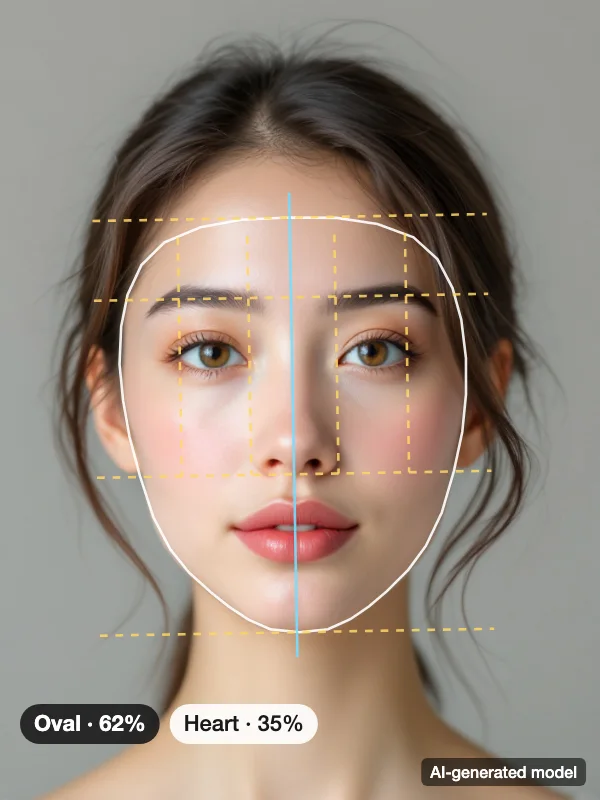
This face analysis starts from one front-facing selfie. MediaPipe Face Landmarker maps 478 points on your face, in your browser, and the tool turns the distances between them into 21 measurements: ratios, angles and percentages. Each one compares one distance with another or measures an angle, so how large your face appears in the frame does not matter. The measurements fall into five groups, the same ones your result uses.
Face shape and width
- Face length to width: estimated hairline-to-chin length over cheekbone width, the main input for your face shape.
- Cheekbone to jaw width: how much narrower the jaw is than the cheekbones.
- Forehead to cheekbone width: forehead width at the level of the brow arches, over cheekbone width.
- Jaw angle: a front-view estimate of the angle at the jaw corner. Larger reads softer, smaller reads more defined.
- Chin width to mouth width: how broad the chin is next to the mouth.
- Facial width-to-height ratio: cheekbone width over the height from the brows to the upper lip, a ratio used in research.
Vertical balance
- Facial thirds: forehead, mid-face and lower face, each compared with the middle third. The top third is an estimate, since hair can hide the hairline.
- Lower-third split: how the space from the base of the nose to the chin divides around the mouth.
- Eye-to-mouth distance to face length: the drop from the pupils to the mouth, over face length.
Eyes and brows
- Horizontal fifths: eye width, the gap between the eyes, and eye width again, side by side.
- Eye spacing to eye width: the gap between the inner eye corners, counted in eye widths.
- Pupil distance to face width: pupil to pupil, over cheekbone width.
- Eye height to width: how open the eyes are, the basis of almond versus round on the what is my eye shape page.
- Eye corner tilt: the angle from the inner to the outer eye corner, also called canthal tilt.
- Brow-to-eye distance: from the lower edge of the brow to the upper lid, relative to eye height.
Nose and mouth
- Nose width to eye spacing: nostril width over the gap between the inner eye corners.
- Mouth width to nose width: corner to corner of the mouth, over nose width.
- Lower to upper lip height: the height of the lower lip over the height of the upper lip.
Symmetry and classic ratios
- Left–right symmetry: how closely mirrored points on the two sides match, as a percentage. The face symmetry test explains the scale.
- Midline offset: how far the nose tip and chin sit from the center line of your face, as a share of face width.
- Golden-ratio closeness: how far six classic ratios sit, on average, from 1.618, a design rule of thumb rather than a scientific standard.
Each value sits next to a reference range in the full report. A number outside its range describes your face in that one respect, and the report explains what it means for styling and photos.
Facial harmony: what the score covers
The Harmony Score is the facial harmony number in your result: one figure, shown on a 40–98 range, that summarizes how six proportions sit next to reference values.
- Thirds balance: the height of your lower third compared with your middle third. The forehead third stays out of the score, because the hairline is hard to place from a photo.
- Fifths: the width of each eye compared with the gap between them.
- Symmetry: how closely your left and right sides mirror each other.
- Eye spacing against face width: compared with a reference near 46%, from a 2010 study of face images by Pallett, Link and Lee.
- Eye-to-mouth distance against face length: compared with a reference near 36%, from the same study.
- Golden-ratio closeness: included at a low weight, since 1.618 comes from design rather than from the study of faces.
What the score leaves out matters just as much. It measures geometry only: not attractiveness, skin, expression, style, grooming or personality, and it does not predict how anyone sees you. Treat a facial harmony test like this one as a description of proportions, useful when you choose frames or set up a photo, and not as a verdict. The attractiveness test page explains why a single photo cannot rate looks.
Free face analysis vs. the full report
The free face analysis covers the essentials:
- your face shape, or "Between X and Y" when two shapes are close
- the Harmony Score
- face length ÷ width
- facial thirds
- left–right symmetry
When you scan from this page, the result also lists all 21 measurements by group and marks the free ones, so you can see what the report adds before deciding.
The full report is a one-time payment of $12.99, with no subscription. It adds:
- all 21 measurements with their values, reference ranges and confidence levels, each explained in plain words
- a symmetry map, region by region
- styling suggestions based on your face shape and measurements
- a PDF to keep
The free result stands on its own. The report is there if you want every number and what it means for your styling.
How accurate is a face analysis from one photo
Any face analysis test that works from a single photo gives an estimate, because a flat picture of a three-dimensional face depends on how it was taken. The main influences:
- Lens distance: up close, a front camera enlarges whatever is nearest, usually the nose and the center of the face. At about 1 meter (3 feet), proportions come through more faithfully.
- Head pose: a slight turn narrows one side and widens the other, and tipping your chin up or down changes every vertical measurement.
- Expression: a smile widens the mouth, lifts the cheeks and narrows the eyes.
- Hair over the forehead or jaw: covered edges have to be estimated, which is one reason the top third is always an estimate.
- Lighting: a strong shadow on one side makes points harder to place there.
That is why every measurement shows a confidence level: high, medium or low. Eye spacing, measured between well-defined eye corners, is marked high; the jaw angle, which a front photo sees poorly, is marked low. Before reading much into a small difference, compare two photos taken the same way.
Privacy: nothing leaves your device
The face analysis runs entirely in your browser. Your photo is measured on your device and never uploaded, and the 478 points stay there too. The result is kept in this browser for 24 hours, then cleared automatically, and you can clear it sooner.
If you buy the full report, only the derived measurements, the ratios and angles, are sent to the server so the report can be built. The photo never is. The tool does no face recognition, no identity matching and no guessing of age, gender, emotion or ethnicity, and it is meant for adults 18 and over. For the outline of your face on its own, the face shape detector explains all seven shapes.
Updated 2026-09-26