What are upturned eyes?
Upturned eyes are eyes whose outer corners sit higher than the inner corners. Draw a line from the inner corner of one eye to its outer corner and it rises toward the temple, where on most eyes it runs close to level. The name says nothing about the size of the eye, how open it is or how far apart the two eyes sit. It describes one line.
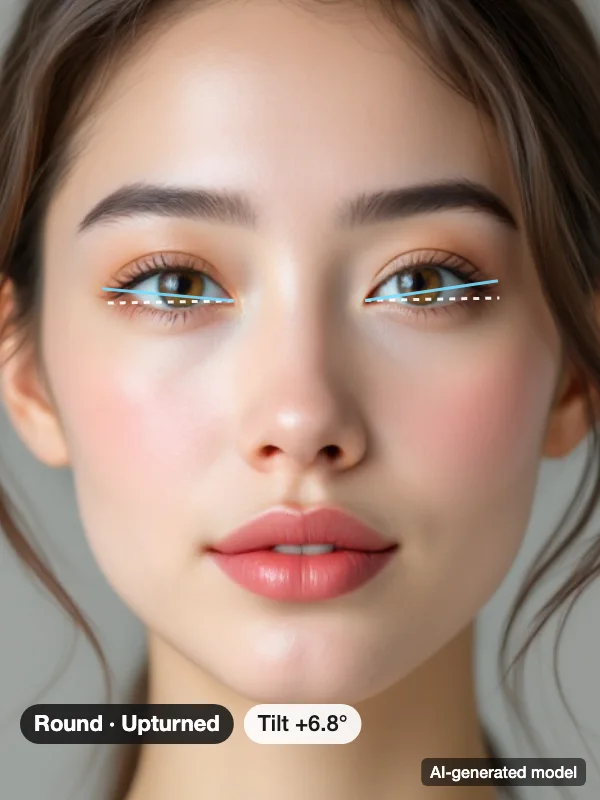
The detector on this page measures that line in degrees. It finds the inner and outer corner of each eye among the 478 points it maps on your face, takes the angle between them against your face's own horizontal, and averages the two eyes. At 5° or more, the result reads as upturned. From 1° below level to 5° above, the corners read as level, and more than 1° below level reads as downturned. The average line rises by about 1.7°, so a slight upward tilt is the ordinary case and only a clear one earns the label. The cut-offs are drafts, still being tuned on annotated photos.
How to check for upturned eyes on a photo
A mirror is not much help with angles, because you tend to tip your head while you look. A photo is steadier. Hold the camera at eye level, about 3 feet away, keep your head upright and your face relaxed, and take a straight-on shot.
Then lay the edge of a card across the two inner corners. On upturned eyes, both outer corners sit visibly above that edge. If they sit on it or only just above it, your corners are level, which is what most people find. A difference of two or three degrees is nearly impossible to see without drawing the line, and that is the part the scanner does for you: it draws the corner line of each eye over your photo and shows the angle with the result.
Watch the chin. Tipping it down lifts the outer corners in the picture, and tipping it up lowers them, because the outer corners sit farther back on the face than the inner ones. The scanner measures against the face's own horizontal, so leaning your head toward one shoulder does not change the reading, and it rejects photos where the head is tipped or turned too far. Small tips still nudge the number, so keep the lens level with your eyes.
Upturned eyes and canthal tilt
The corner line has a technical name, the canthal tilt, and the two pages on this site read it with different words. The canthal tilt page calls the angle positive when the outer corner is more than 1° above the inner corner, neutral within 1° either way, and negative below that. The eye shape result uses wider bands, because it is choosing a styling label, not describing an angle: it takes 5° to say upturned.
So a reading of 3° is a positive tilt and level corners at the same time. Both statements are true. If your number is between 1° and 5°, think of your eyes as level with a slight lift, and borrow from the upturned tips only if you like the effect.
Upturned or downturned: reading the middle
Most confusion about upturned vs downturned eyes comes from the middle band. The two labels are not neighbors. Between them sits level, six degrees wide, and that is where the average eye is. Upturned starts at 5° above level and downturned eyes start more than 1° below it, so nobody moves from one to the other because of lighting or a slightly different photo.
What can happen is a reading near one line. At 4.6° one day and 5.2° the next, the label flips between level and upturned while the eye stays the same. The result marks readings that sit within three quarters of a degree of a line, so you know when to read the label loosely.
Eyeliner for upturned eyes
Eyeliner for upturned eyes can stay simple, since the lift people try to draw with a wing is already there. A thin line along the upper lashes, ending in a short flick that continues the corner instead of climbing above it, is usually enough. A long, steep wing stacks a second lift on top of the first, which reads as dramatic. That is fine if drama is the plan.
The balancing move sits on the lower lash line. A little shadow or soft pencil under the outer third adds weight below the corner and evens out the rise. Keep it soft and short; a hard line all the way along the lower lid makes the eye look smaller.
Eyeshadow, brows and glasses for upturned eyes
Makeup for upturned eyes follows the liner. Keep the deepest shadow on the outer third of the lid and blend it outward more than upward, then repeat a touch of the same shade under the outer lower lashes. Shadow swept up toward the tail of the brow exaggerates the tilt.
Brows work the same way. A straighter brow, with a low arch and a tail that does not climb, keeps the lift from doubling up. A high, pointed arch over a rising corner line makes both look steeper.
For glasses, straight or softly rounded frame tops sit calmly with the lift, while a strong cat-eye repeats it. Choose the width by your face and not by your eyes: the glasses for face shape guide shows which frames suit each face shape.
Upturned eyes with other labels
Upturned is the second word of a result, never the first. Every result starts with the opening, almond or round, and adds the tilt after it: "almond, upturned" or "round, upturned". A long, narrow opening with a rising corner line is the upturned eye shape often called fox eyes or cat eyes, though the scanner does not use either name.
When two or three labels appear, use each tip for its own part of the eye. The opening decides how thick the liner should be and where; the tilt decides the direction of the flick; the spacing decides where the darker shadow goes. The almond eyes and round eyes pages cover the opening, and the eye shape detector page explains every label in one place.
Updated 2026-10-06