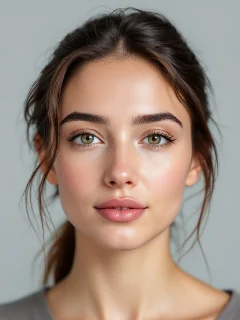
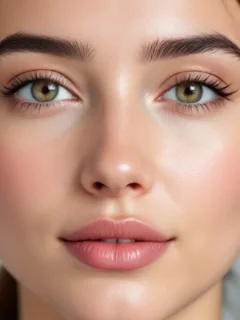
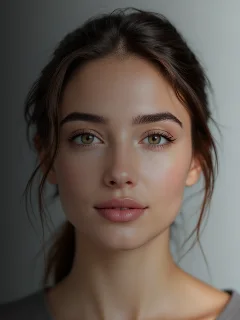
What are wide-set eyes?
Wide-set eyes are eyes with more space between them than the usual proportion. Artists use a simple rule for an average face: the gap between the eyes equals the width of one eye. When the gap is clearly larger than that, the eyes are called wide-set. The term covers spacing and nothing else, so wide-set eyes can be almond or round, level or tilted, large or small.
The scanner on this page measures spacing from a selfie, on its own scale. It divides the distance between the inner corners by the width of the eye, both taken between the corner points it maps on the photo. On those points the average face reads about 1.43, and the usual range runs from 1.25 to 1.6, higher than the one-eye rule would suggest. A reading over 1.6 is shown as wide-set and one under 1.25 as close-set. Compare a scanner reading with the scanner's range, and keep the one-eye rule for measuring by hand. The cut-offs are drafts, still being tuned on annotated photos.
This page is about appearance and styling only: eye spacing is also something doctors assess in their own way, and a selfie cannot answer a health question, so take those to a doctor.
Do I have wide-set eyes? A check by hand
Use a photo taken from a distance. This matters more for spacing than for any other eye measurement, because a phone at arm's length or closer enlarges the middle of the face and widens the gap. Prop the phone about 3 feet away at eye level, face it squarely and use a timer.
On the photo, measure the gap between the two inner corners and then the width of one eye from corner to corner. If the two match, your spacing is average. If the gap is noticeably larger than the eye, you have wide-set eyes by the artist's rule; if it is smaller, see close-set eyes. Treat a difference of a millimeter or two on a phone screen as a tie.
The scanner makes the same comparison with both eyes and their average width. Since the result is a ratio, a bigger face or a larger photo gives the same answer, and a reading close to 1.6 is marked as near the line.
What makes eyes look farther apart
The impression of spacing depends on what surrounds the eyes. A broad, flat nose bridge, brows that begin well outside the inner corners, and hair pulled back from the temples all widen the look. So does makeup that is heaviest at the outer corners, and so do frames that extend past the sides of the face.
The opposite choices narrow it. That is the logic of every tip that follows: add depth and detail near the center of the face, and keep the outer edges quiet. The measurement does not change. The impression does.
Makeup for wide-set eyes
Makeup for wide-set eyes moves the weight inward.
- Eyeliner: take it all the way into the inner corner, and keep any flick short. A long wing carries the eye outward.
- Shadow: put the deeper shade on the inner half of the lid and blend it toward the nose side of the socket; keep the outer half lighter.
- Lower lash line: a soft line from the inner corner to the middle of the eye, fading out before the outer corner.
- Lashes: even length across the lid, or slightly longer at the center, instead of extra length at the outer edge.
Eyeliner for wide-set eyes is the one case where the line should be at its strongest near the nose. Skip the bright highlight at the inner corner that many tutorials recommend. It opens up the space between the eyes, which is helpful for close-set eyes and unhelpful here.
Brows and glasses for wide-set eyes
Let the brows start a little closer to the nose, a few millimeters inside the inner corners of the eyes, and keep the tails from running far out toward the temples. Shading the first part of the brow slightly darker brings the eye inward as well.
With glasses, the bridge does the work. A darker or keyhole bridge draws the eyes toward the center, and a frame that stops at the widest part of the face keeps the outer edges from adding width. The glasses for face shape guide helps with the overall frame; use the bridge to adjust for spacing.
Wide-set eyes with other eye shape labels
A result puts spacing last. It names the opening first, almond or round, then the corner line when it is not level, and then the spacing: "almond, wide-set" or "round, downturned, wide-set". Tips for each part combine. On almond eyes that are also wide-set, a thin line taken right into the inner corner with a short flick covers both.
The round eyes, upturned eyes and downturned eyes pages cover the other labels, and the eye shape detector page shows all of them on one chart.
Why two photos can disagree about spacing
Distance is the usual cause. The same face reads wider-set from 1 foot than from 3 feet, because the lens is closer to the middle of the face than to its edges. A head turned slightly to one side does the opposite: it shortens one eye and squeezes the gap. The scanner rejects photos where the head is turned too far, though a small turn still gets through.
For a number you can rely on, use even light from the front, keep the camera at eye level about 3 feet away and look straight into the lens with a relaxed face. If careful photos land on both sides of 1.6, your spacing is at the edge of average, and either description fits.
Updated 2026-10-06