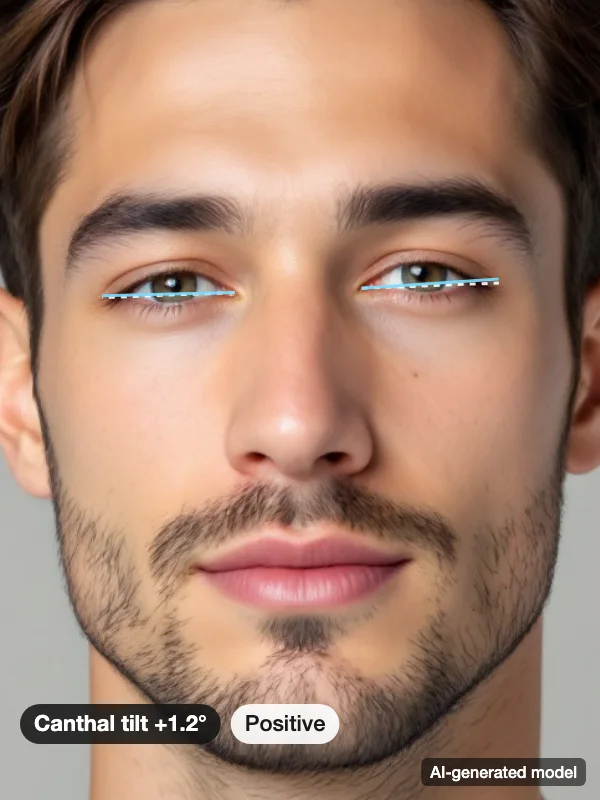



What is canthal tilt?
Canthal tilt is the angle of the line that runs from the inner corner of your eye to the outer corner. The corners have anatomical names, the medial canthus on the inside and the lateral canthus on the outside, and that is where the term comes from. When the outer corner sits higher than the inner one, the tilt is positive. When it sits lower, the tilt is negative. When the two are about level, it is neutral.
The angle is given in degrees, like the slope of a roof or a road. A canthal tilt of +3° means the corner line rises by 3 degrees from the inner corner outward, and −2° means it falls by 2 degrees. The number describes one line on your face and nothing else: not the size of the eye, not how open it looks, and not anything about you as a person.
In everyday words, a clearly positive tilt is what people often call upturned eyes, and a negative one is what they call downturned eyes. Canthal tilt gives those words a number, which is handy when you want to compare two photos or choose where to angle a liner flick. It is also only one part of how eyes are described. How tall the opening is and how far apart the eyes sit are separate measurements, covered on the what is my eye shape page.
Positive, neutral and negative canthal tilt
The canthal tilt test sorts your angle into three bands:
Positive
Outer corner higher than the inner corner, above +1°.
Neutral
Corners about level, between −1° and +1°.
Negative
Outer corner lower than the inner corner, below −1°.
- Positive canthal tilt: above +1°. The outer corner sits higher than the inner corner.
- Neutral canthal tilt: from −1° to +1°. The two corners sit about level.
- Negative canthal tilt: below −1°. The outer corner sits lower than the inner corner.
The bands are narrow because the angles are small. On an eye about 1 inch (2.5 cm) wide, a 2° tilt lifts the outer corner by less than a millimeter. The chart exaggerates its angles so you can see the difference; on a real face, the three bands are much harder to tell apart by eye, which is why measuring helps.
Typical faces measure somewhere between about −2° and +6°, and the average is about +1.7°, so a slightly positive canthal tilt is common. A neutral or negative reading is just as much a part of normal variation. The labels describe direction, the way "uphill" and "downhill" describe a road, and none of them is a goal.
The eye shape result uses wider bands for the same angle: it calls eyes upturned from +5° and downturned below −1°, with straight in between. So an eye at +3° counts as positive here and straight on the eye shape result. Both describe the same line; they simply group the numbers differently.
How the canthal tilt test measures your eyes
The scan runs in your browser, where MediaPipe Face Landmarker maps 478 points on your face, including the inner and outer corners of both eyes. From those points, the canthal tilt test works in three steps:
- It finds your face's own horizontal. The measurement uses the axes of your face rather than the edges of the photo, so head roll, tipping your head toward one shoulder, is removed before anything is measured.
- It measures each eye. For each eye, it takes the line from the inner corner to the outer corner and measures its angle against that horizontal, in degrees, positive when the outer corner is higher.
- It reports both. Your result gives the average of the two eyes with its band, then each eye's own angle, because the two sides of a face are rarely identical.
Here is how that can look in practice. Say your right eye reads +2.4° and your left eye +0.8°. The average, +1.6°, is above +1°, so the result calls it positive, even though the left eye on its own would sit in the neutral band. Splits like this are normal, and a retake facing the camera squarely shows how much of the gap came from the photo. If the two eyes still differ after a careful retake, that difference is simply part of your face.
On your photo, and only on your device, the result draws the lines it measured: a dashed line for your face's horizontal and a solid line through both corners of each eye. If a point landed in the wrong place, for example on a shadow or along the lash line, you can see it, and a retake in softer light is worth trying.
The cut-offs are drafts that are still being tuned on annotated photos, so treat a reading within a few tenths of a degree of a band edge as sitting on the line. The same angle also appears as eye corner tilt among the 21 measurements of the face analysis, next to eye height, eye spacing and brow-to-eye distance.
Why canthal tilt changes between photos
Because the angles are small, the photo can move a canthal tilt reading more than you might expect. The usual causes:
- Chin up or down. Your outer eye corners sit further back on the head than your inner corners. Tip your chin down and the outer corners look higher, so the reading rises; tip it up and the reading falls.
- Camera height. A camera above eye level works like tipping your chin down, and a camera below eye level like tipping it up. A selfie held high and one held low can disagree for this reason alone.
- Head turn. Turning toward one side changes how each eye is seen, so the left and right angles drift apart.
- Expression. A smile lifts the cheeks and reshapes the lower lids, and squinting narrows the opening. Both move the corner points.
- Lens distance. Up close, even a small gap between camera height and eye height becomes a steep viewing angle. At about 1 meter (3 feet), the same gap matters much less.
- Shadows and glasses. A shadow at the corner, or a frame over it, makes the corner point harder to place.
Tipping your head toward one shoulder matters much less, because the test measures against your face's own horizontal. And since the neutral band is only 2 degrees wide, even a slight nod can move a reading from one band to the next. That is a change in the photo, not in your eyes.
The same goes for older pictures. Photos taken on different phones, at different distances and with your head at different angles will give numbers that wander, so they make a poor record to compare against. If you want to compare over time, take new photos with one fixed setup, like the one described at the end of this page, and compare only those with each other.
Canthal tilt, eyeliner and glasses
Makeup and frames can follow your canthal tilt or play against it. Both are fine choices, and the angle you start with does not limit what you can wear. These notes match the upturned and downturned tips in the eye shape result:
- Negative tilt: angle your liner flick slightly upward and keep liner off the outer lower lash line. Cat-eye or upswept frames lift the outer edge of the frame line.
- Neutral tilt: most liner shapes work. A flat flick follows your line, and an angled one adds lift when you want it. Most frame shapes sit well.
- Positive tilt: most looks follow it naturally. With a strong lift, a little shadow along the outer lower lash line balances it, and frames with straight or softly rounded tops sit calmly with the angle.
When you draw a flick, check it with your eyes open and looking straight ahead. Looking down into a mirror changes how the lid and the outer corner sit, so a flick that looks right while you look down can point at a different angle once you face people or a camera.
The top edge of a frame acts like a second line near your eyes, so it can echo your own angle or soften it. The easiest way to choose is to photograph two options in the same light and from the same distance, then keep the one you like.
Taking a photo for a steady canthal tilt reading
To compare readings over time, or simply to get one you trust, keep the setup the same each time:
- Put the camera at eye level, about 1 meter (3 feet) away. Prop your phone on a shelf or ask someone to hold it.
- Face the lens straight on, with your chin level, neither raised nor tucked.
- Relax your face: eyes open naturally, no smile, no squint.
- Take off your glasses and move hair away from the outer corners of your eyes.
- Use soft, even light from the front, so neither corner sits in shadow.
Two careful photos can still differ a little, and that is ordinary measuring noise. Your scan also includes your face shape and a Harmony Score, and if you are curious about classic proportions, the golden ratio face calculator compares six of them with 1.618.
Updated 2026-09-26